

In different languages
Tomas Tranströmer
- read in Danish by Karsten Pharao
- read in Estonian by Jarmo Reha
- read in Finnish by Caj Westerberg
- read in German by Michael Krüger
- read in Icelandic by Hjörtur Pálsson
- read in Latvian by Baiba Broka
- read in Lithuanian by Zita Mažeikaitė-Sajiene
- read in Lithuanian by Indrė Valantinaitė
- read in Norwegian by Jan Erik Vold
- read in Russian by Alexei Khairetdinov
- read in Sami by Nils-Henrik Sikku
- read in Swedish by Tomas Tranströmer
Jarmo Reha in Tallinn

Karsten Pharao in Ruds Vedby
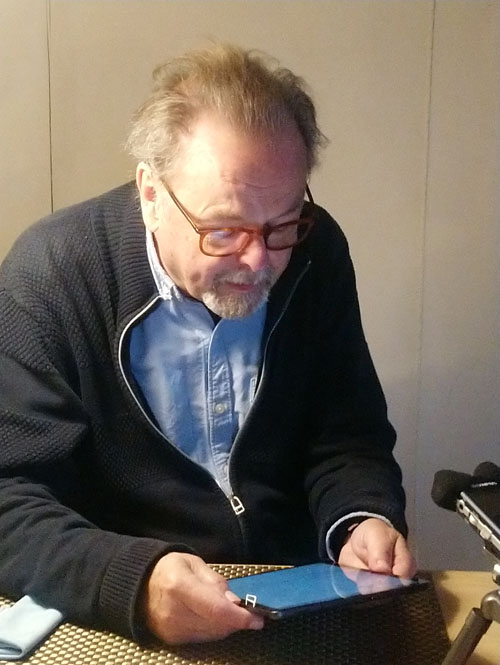
Zita Mazeikaite in Vilnius

Nils-Henrik Sikku in Jokkmokk

Johannes Bobrowski
read by Klaus Völker
- D.B.H.
- Kindheit
- Das Dorf Tolmingkehmen
- Lettische Lieder
- Bericht
- Kaunas 1941
- Aleksis Kivi
- An Ulla Winblad
and in Estonian by Aare Pilv
Sigitas Geda
- Angelas krintantis Palangoj
read in Lithuanian by Sigitas Geda - Angel falling in Palanga
read in English by Kerry Shawn Keys and accompanied by Vladimir Tarasov
In Danish
Klaus Rifbjerg
In German
H.C. Andersen
- Die kleine Meerfrau
read by Ole Svendsen
Aino Kallas
- Der Pfarrer von Roicks
read by Elna Lindgens
Barbara Lönnqvist
- Porträt einer Zeit: Anna Achmatowas lyrisches Werk
read by Mareen Bruns
Johannes Salminen
- Das Alexandria der Ostsee
read by Elna Lindgens
In Lithuanian
- vakar yra rytoj
- read by Vladas Braziunas
In Swedish
Henry Parland
- Vår i Kaunas
- read by Clas Zilliacus
At the Water's Edge: Sound collage
1. [DANSK]
Noget af det første, jeg kan huske er faktisk Østersøen - selvgølgelig vidste jeg ikke dengang, at det var Østersøen, jeg maa have været fire aar og det er snart 60 aar siden. Vi var paa ferie med familien i fiskerlejet Tejn paa Bornholm. Jeg husker, at jeg ligger paa maven paa en badebro af træ. Der er brede sprækker mellem broens bræddter, som er dejlit varme af solen og lidt ru. Jeg kikker gennem en af sprækkerne og under mig glitrer vandet i striber, fordi solen jo skinner gennem broens sprækker ned paa Østersøens vand.
My first memory is actually the Baltic Sea. Of course I did not know it at that time, I must have been four, and it is sixty years ago. We were on vacation with the family in the fishing village Tejn at Bornholm. I remember that I am lying on the stomach on a wooden bathing bridge. The wide boards are warmed by the sun. I am looking down through the gaps between the boards. Under me the water glistens in stripes while the sun shines through the bridge gaps on the Baltic Sea water.
2. [РΥСCKИЙ]
Теоретически мы понимали, что живём рядом с прекрасным морем, но практически мы не могли до него добраться. Все дороги были разбиты. Вдобавок пока ещё не ходили поезда в Светлогорск и Зеленоградск. Однажды мы из ≪Комсомольца≫ попросили нашего шефа-оперативника одолжить нам его машину, чтобы съездить на море. Он согласился.
Theoretically we knew we lived near a beautiful sea, but practically we had no way of getting to it. The roads had all been destroyed. In addition, there were no passenger trains to Swetlogorsk and Selenogradsk yet. Once we Komsomolets asked our chief operating officer whether he would lend us his car for a drive to the sea. He let us have it.
3. [DEUTSCH]
Joachim: Was war die Ostsee? Es war ein schöner, weißer Strand, von dem wir nicht wussten, dass es von dieser Art von Qualität von Sand nur wenige gibt in Europa oder in der Welt, und da draußen fuhren ein paar Kriegsschiffe lang.
Ines: Nee, an der Ostsee hast du doch nicht an Kriegsschiffe gedacht!
Joachim: Die fuhren doch da!
Joachim: What was the Baltic Sea? It was a beautiful white beach which we didn’t know had sand so wonderful you don’t find much of anything like it elsewhere in Europe or the rest of the world, and out there on the sea, a few battle ships passed by.
Ines: Nope, you didn’t think about battle ships when you were at the Baltic Sea!
Joachim: But they were passing by right there!
4. [LATVISKI]
Mani zēni, tik jauni, nevarēja nekādi rimties, viņiem bija jāiet uz jūrmalu. Es teicu: “Viņi jūs kādu dienu ieslodzīs, un jums būs jāmaksā sods par vāļāšanos pludmalē.” Jūrmalā bija stabi un dzeloņdrātis, tāpēc īstenībā jūras krastā nemaz nevarēja tikt. Bet puikas izmantoja nūjas, lai kaut kā tiktu pāri, un uzāva vecus zābakus ar biezām zolēm, lai dzeloņi nepārdurtu kājas. Viņi tika pāri un pavadīja laiku pludmalē. Viņi neskaitāmas reizes nokļuva Labraga militārajā bāzē, sēdēja bunkurā, mizodami kartupeļus un tīrīdami tualetes, bet, vienalga, viņi gāja uz jūrmalu.
My boys, such youngsters, they couldn’t stay calm, they just had to go to the beach. I said: “They’ll lock you up one day, and you’ll have to pay a fine for loitering on the beach.” There were poles and barbed wire over there, so you couldn’t actually get to the beach. But the boys used sticks to get across somehow, and wore old boots with thick soles so the barbs wouldn’t pierce their feet. They got over and spent their time on the beach. So many times they ended up in Labrags military base, sat in the bunker peeling potatoes and cleaning toilets, but still they went to the beach!
5. [EESTI]
Meie dokumendid viidi torni. Nad helistasid piirivalve peakontorisse ja meie randaminek registreeriti. Siis tõid valvurid meie dokumendid tagasi ja soovisid meile meeldivat päeva rannas.
Ehkki me olime oma külaskäigu nõuetekohaselt registreerinud, kontrolliti meid mõnikord. Sõjaväedžiip sõitis rannale, kus me päevitasime, ja kõiki dokumente kontrolliti veel kord. Harvem oli meil tegemist jalgsipatrulliga, kellel oli alati suur koer rihma otsas kaasas.
Kui sul ei olnud dokumente ette näidata, viidi sind jaama ja peeti kinni, kuni isik kindlaks tehti. Sealt koju pidid ise saama. Pärast kella kümmet õhtul mere äärde minna oli väga ebasoovitatav.
Our documents were taken to the tower. They telephoned the main office of the border guards and our access to the beach was registered. Then the guards would return with our papers and wish us a good day at the beach.
Even though we had registered our visit with all due diligence, we were sometimes checked. A military jeep would roll up to where we lay sunbathing and all documents would be examined once more. Less often we would be approached by a patrol squad on foot, but they always came with a huge dog on a leash.
If you had no documents to show, they would drive you to the station and hold you there until your identity was confirmed. From there you’d have to get home on your own. Going to the sea after 10 pm. was highly inadvisable.
6. [ LIETUVIŠKAI]
1959 metais persikraustėme į Palangą. Tuo metu Palanga buvo visasąjunginis kurortas, į kurį suvažiuodavo poilsiuotojai iš visos Sovietų sąjungos. Su tėvai retai kada ėjau prie jūros. Gyvenant kurorte visada trūkdavo laiko poilsiui.
We moved to Palanga in 1959. At that time Palanga was a resort town for the whole Soviet Union. Vacationers from all over would come there. I seldom went to lie on the beach with my parents because living in a resort town there was little time for resting for them.
7. [SVENSKA]
Jag seglade jättemycket i Östersjön, runt överallt, utom där borta där det var Sovjet. Det fanns inte, det var ett intetland. Det var helt otänkbart att bege sig dit. Jag kommer ihåg, nångång, det måste ha varit sjuttiotal, vi gjorde nåt försök att få tillstånd att segla till... jag kommer inte ihåg om det var Riga eller Tallinn. Men det var hopplöst, det gick liksom inte. Det hade ju varit skithäftigt, det hade ju slagit en månlandning.
I was sailing a lot in the Baltic Sea, around overall, except over there where the Soviet Union was. It did not exist, it was a no-land. It was unthinkable to go there. I remember, once, it must has been in the seventies, we tried to get permission to sail to... I don't remember if to Riga or Tallinn. But there was no chance. It would have been incredible. It had exceeded a moon landing.
8. [POLSKI]
Przywoziliśmy do Polski różnego rodzaju rzeczy, bo wielu tam nie mieliśmy, na przykład kawy rozpuszczalnej, która była wielkim hitem w tamtych czasach, albo żyletek, tych od Gillette z bardzo zarośniętym facetem na opakowaniu. Potem przyszedł czas na nylonowe płaszcze i koszule. Kiedy zaczęliśmy pływać do Afryki, zwłaszcza przed świętami Bożego Narodzenia, przywoziliśmy pomidory z Las Palmas. W Afryce za to bardzo ceniono sobie Wodę Prastarą, a krem Nivea był bardzo popularny. Czasami widywaliśmy miejscowych robotników w koszulkach z logiem „Odry Świnoujście” na plecach.
Taki prywatny handel uzupełniał nasze dochody.
We brought all sorts of things back to Poland, there were many things we didn’t have: instant coffee for example, a huge hit at that time, also razor blades, the ones from Gillette, with the very unshaven elderly man on the package. Then there was a time of nylon coats and shirts. When we started sailing to Africa, especially before Christmas, we brought tomatoes back from Las Palmas. Going the other direction, the eau de cologne Woda Prastara was really popular in Africa, as was Nivea cream, huge hits there.
This private trade supplemented our income.
9. [РΥСCKИЙ]
Это были трудные времена, но мы были молоды и старались не только выжить, но и веселиться! Наши мужья-моряки приходили из рейсов с чемоданами, полными денег – их зарплата за все эти долгие месяцы в море, но купить было нечего. У нас была большая группа друзей со всеми детьми, и мы все помогали друг другу – и купить еду у контрабандистов-охотников, и своими силами устроить каникулы для детей. Эта была наша молодость – прекрасная, несмотря ни на что.
Those times were difficult, but we were young and tried not only to survive but also to have fun! Our guys were sailors who would come back from long sea voyages with suitcases full of money – their salaries for all those months, but there was nothing to buy. We had a big group of friends with all their children who all helped each other – both to buy food from smugglers and to arrange holidays for the kids. That was our youth and it was fine despite all that.
10. [SUOMI]
Ajoimme sinne usein pyörillä, lokit kirkuivat, meri tuoksui, mutta merelle ei ollut menemistä. Äiti huokaili raskaasti, pysähtyi ylämäessä lähellä entistä kotiaan ja kertoi taas saarísta ja rannoista siinä aivan lähellä, vain muutaman sadan metrin päässä. Lopulta kaikki nämä saaret ja rannat olivat kuin runoa ja mystiikkaa meille lapsille – Paatio, Pitkäpaasi, Pajusaari... Kiiskilahti, Orslahti, Laitsalmi, siellä ne olivat aivan lähellä – ja täysin saavuttamattomissa.
The sound of seagulls in my ears and the smell of the sea in my nose but the sea we couldn’t get any closer to. My mother would stop sometimes while bicycling up a small hill, sigh deeply and again tell me about all the islands and beaches, the closest one just a couple of hundred metres away, that were just beyond our reach. Their names adopted an increasingly lyrical and mystical character in mind – Paatio, Pitkäpaasi, Pajusaari... Kiiskilahti, Orslahti, Laitsalmi – so close yet inaccessible.